Most stories about Long Covid are told in symptoms. Fatigue, fog, and the day nothing went back to normal.
This one is told in blood.
In March of 2020, tens of millions of people caught what they assumed was a fairly ordinary case of Covid. Four days of fever. Two weeks in which the world went strangely odorless: coffee, rain, their own skin, all of it blank. Then most of them got better. The way the story is supposed to end.
Except that for a substantial number, the fatigue never left.
They went to their doctors. They had their blood drawn. The results came back normal.
This is a story about what those tests missed.
5 min read
I
The most tested organ in medicine
Here's what your blood is doing right now, while you read this sentence: moving roughly five liters of fluid through tens of thousands of miles of vessels, most of which are so narrow that a single blood cell has to fold in half just to pass through. Carrying oxygen out. Carrying waste back. An errand it has run without pause since before you were born.
It's the least dramatic organ in the body. No one paints it, no one writes poems about it. And it is almost certainly the tissue medicine asks about more than any other: a vial of it is the default first question for nearly every complaint anyone brings through a door, because it's the one organ you can take repeatedly, cheaply, without opening anyone up.
Which produces a strange situation. Blood is sampled constantly and examined almost never.
A standard panel looks things up. It doesn't really look. What it measures is a fixed list of things in your blood: cholesterol, glucose, thyroid hormone, white cell count, a few dozen others, and whether each one falls inside a range built from the general population. Every entry on that list is there because medicine already learned to name it, in most cases decades ago.
So a normal result simply means no match against the list of known disease markers. It has never meant that no underlying cause is present.
For most of medical history the distinction didn't matter much, because the list was good enough for the things people usually had. Then, starting in 2020, people began arriving with something that wasn't on it.
Capillary network. The bloodstream at its smallest scale.
II
Three candidates still circulating
Three labs went looking outside the list. What they found only makes sense against the strange fact about Long Covid: it starts after the infection ends.1
So, briefly, what's supposed to happen. The immune response runs on a dial. When something arrives that the body has no existing instructions for, it turns up in proportion to how dangerous the threat appears: inflammation loosens vessel walls so immune cells can reach infected tissue, raises temperature, floods the area with signalling proteins. All of it costly, all of it deliberate. In the overwhelming majority of cases, once the threat clears, the dial comes back down, and what's left behind is memory: a small standing population of cells that will recognise the same virus faster next time.
All of that travels by blood. The cells, the signalling proteins, the debris of the fight itself: the bloodstream is how a response is delivered and how it's carried away afterwards. The virus leaving is the first half of recovery. The clearing is the second.
Which is why, when a response doesn't fully shut down, the blood is where you'd expect to find what's left: whether or not the panel has a line for it.
Three findings, from three separate labs. Each describes something still circulating months after every standard test said the infection was over.
1
The clots too small to have a name.
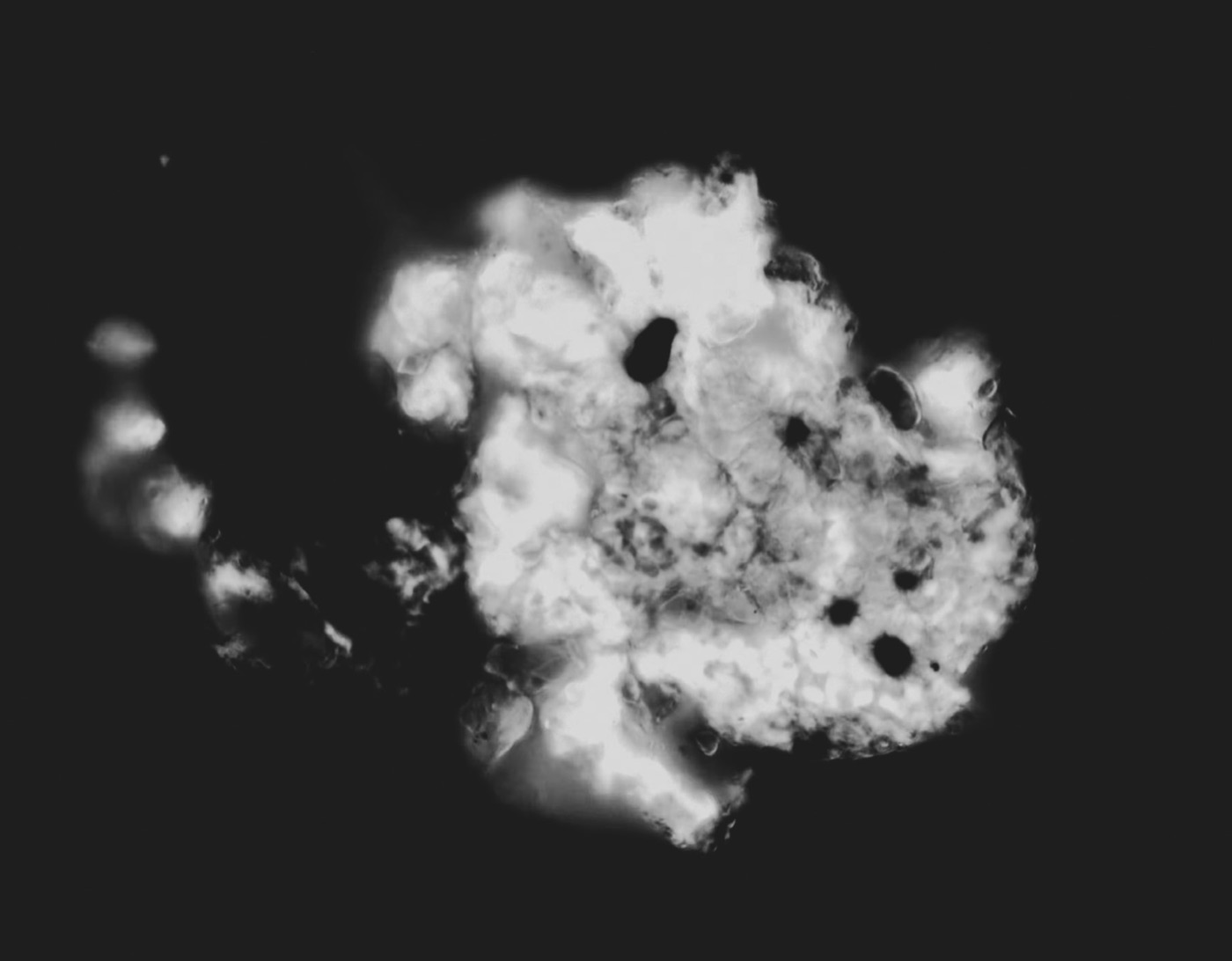
Resia Pretorius and colleagues spent years looking through a microscope at microclots: tiny, amyloid-like structures, small enough to slip past a standard blood panel without tripping a single alarm.2 In some Long Covid patients, clots like these have been observed lingering in plasma well after the acute infection resolved, potentially narrow enough to slow flow through the capillaries, the smallest vessels in the body, and the ones that deliver oxygen to muscle and brain.
This is exactly the kind of finding that's tempting to oversell, so it's worth being precise about what it isn't: it hasn't been established as the mechanism behind Long Covid, the original observations came from a small sample, and it doesn't appear in every patient with the diagnosis. But it is one of the first findings to offer a potential physical cause for symptoms like brain fog and fatigue, which standard medicine had no way to explain.
Microclot, fluorescence microscopy. Click to enlarge.
2
The antibodies that stopped telling the difference.
Antibodies work by shape. The immune system builds one to fit a piece of the virus, and from then on anything carrying that shape gets attacked.
In a subset of COVID-19 patients, researchers found antibodies fitted to the body's own tissue rather than to the virus that produced them: a wide range of them, some directed at blood vessels, some at connective tissue, some at the nervous system.3
The mechanism itself is familiar. It's roughly what happens in Lupus and other autoimmune conditions: antibodies attacking tissue they were never built to target. What's new is finding it downstream of a respiratory virus, in people with no autoimmune history a year earlier. The leading explanation is molecular mimicry: some viral proteins resemble the body's own closely enough that an antibody built for one also fits the other.
Which explains something the first finding doesn't. An immune response ends when its target is gone. If part of the response is aimed at the body, the target never leaves.
Why it happens to some patients and not others remains an open question.
3
The all-clear that never came.
Think about the last time you had flu. The heaviness, the wanting to lie down, the not being able to think: all of that is the immune system talking to the rest of your body.
That conversation runs on proteins called cytokines, and much of it is instruction. Stop. Rest. Stay down. Put whatever energy is going elsewhere into this. What we experience as being ill is largely the body complying.
Which means recovery takes two things. The threat has to clear, and the instruction has to be lifted.
In some Long Covid patients, markers of that signalling stay elevated for months after any standard test says the infection is over.4 Part of the system is still sending threat detected. The body is doing what it's told.
So the fatigue is the correct response to a message that was never withdrawn.
Three threads: clots that shouldn't be circulating, antibodies pointed the wrong way, an all-clear that never came. No single mechanism ties them together yet, and it's possible none does. One patient's fatigue may come from the clots, another's from the antibodies. What looks like one condition could turn out to be several.1
What all three have in common is that they were found in blood.
III
Normal was never a finding
All three of those findings were made in blood. Which raises the obvious question about the millions of normal results.
The same account recurs, with very little variation:
"Every test came back normal. That was the hardest part. Nothing showed up wrong, and I still couldn't get through a day."
— representative of phrasing common in patient accounts
So take the three findings in order.
Pretorius's group found microclots by staining plasma with a fluorescent dye and examining it under a microscope. That's a research technique. No hospital lab runs it on request. The autoantibody screen tested against roughly 2,700 proteins at once, where clinical autoantibody testing checks a short predefined list, each entry tied to a disease already named.
The third case is the most telling. The test exists, it was run, it worked correctly, and it returned a normal result.
But normal is a statistical average of a population, not a measure of your personal health. A reference range is built from other people: measure a large group considered healthy, and the middle of that spread becomes normal. Because nobody measured you when you were well, there is no line on the chart for the person you used to be, and a value that has shifted dangerously from your own baseline can still sit comfortably inside everyone else's average.
Which is why a persistent low-grade elevation can sit inside normal for months, while sitting well outside where it used to be for the person it belongs to.
Every doctor reading that result is reading the same chart.
This points to a deeper, systemic limitation. A standard panel is built backwards: every entry on it exists because a disease was named first, then a marker was found, then a range was set. The list is a record of what medicine has already learned to recognise. A cause no one has named yet arrives invisible, and stays that way until enough people turn up with it that someone goes looking outside the list.
That is what happened after 2020. It will happen again.
So the next time a result comes back normal, it's worth knowing what the word covers. It means nothing on the list was out of range. What wasn't on the list is still an open question.
There's no settled treatment yet. None of the three findings comes with one.
What has changed is that one of the three can now be looked at directly. Microclot analysis has moved out of the research lab and into a small number of clinics, Ayus among them: examining plasma for structures a standard panel was never designed to catch. The research is unsettled and the finding doesn't appear in every patient. Some clinics have begun working on clearance as well as analysis. That work is early.
1Proal, A. D. & VanElzakker, M. B. (2021). Long COVID or post-acute sequelae of COVID-19 (PASC): an overview of biological factors that may contribute to persistent symptoms. Frontiers in Microbiology, 12:698169. Source for the heterogeneity of routes to the same symptoms.
2Pretorius et al., 2020 / 2021, as reviewed in Proal & VanElzakker (2021). Plasma microclots shown by fluorescence microscopy with thioflavin T staining. The PASC plasma sample was 11 subjects, and replication remains limited: the least settled finding in this piece.
3Wang, E. Y. et al. (2020). Rapid Extracellular Antigen Profiling screen of 194 COVID-19 patients against 2,770 extracellular and secreted proteins.
4Persistent cytokine elevation in a subset of patients. Reported across several cohorts; no single citation is settled, and the observation should be read as provisional.
Microclot under fluorescence microscopy. Click anywhere to close.